


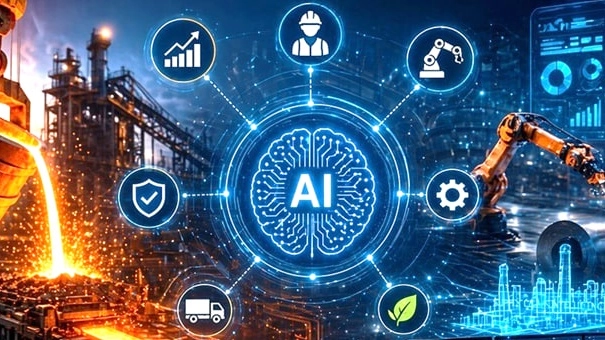
Foundry production is one of the key industries, which remains the main procurement base for metalworking for mechanical engineering, automotive engineering, shipbuilding, instrument making, agro-industrial complex, construction, transport, infrastructure, defense-industrial complex, etc. This industry provides the manufacture of a wide range, complexity (configuration), mass of parts from various structural, both metal alloys, and non-metallic materials.
The development of the global and domestic modern foundry industry implies an increasing need for the use of digital technologies, opening up new opportunities for optimizing and improving the processes of manufacturing cast products (parts).
It is artificial intelligence, as one of the tools of digital transformation, that is becoming that key factor.
Let’s consider the main areas of application of artificial intelligence technologies in foundry production.
One of the most important areas of implementing artificial intelligence technologies in foundry production is defect prediction.
The developed algorithms of intelligent systems can analyze large amounts of data, namely: temperature regimes, gas-hydrodynamic pressure in the casting mold, melt pouring rate, characteristics of molding materials, gas permeability of molding and core mixtures, chemical composition of the molten alloy, duration, as well as conditions for crystallization of castings in casting molds.
Based on this data, artificial intelligence algorithms can detect patterns and create models that can accurately predict the likelihood of porosity, shrinkage cavities, hot cracks, welds, and other typical casting defects before the alloy is poured and solidified. Such systems allow technologists to adjust process parameters in advance, preventing the release of defective products and reducing the amount of rework.
Automated technical control systems based on artificial intelligence algorithms are radically transforming the process of assessing the quality of cast products. Computer vision methods, combined with sophisticated deep neural networks, can provide image analysis – from high-contrast radiographs to video from visual cameras – and automatically detect both surface and internal defects.
Unlike traditional visual inspection, such systems provide:
• higher objectivity and reproducibility;
• real-time control;
• a sharp decrease in the impact of the human factor;
• the ability to sort, reject and create statistical quality databases. This significantly increases the efficiency and speed of the production cycle.
A similar approach can be applied to engineering materials science.
Combined with artificial intelligence algorithms, this methodology allows:
• model the microstructure of castings at the level of crystal grains;
• predict the mechanical and other operational properties of the product at the design stage;
• conduct virtual experiments, analyze structural components;
• significantly accelerate the development of new alloys along with the design of cast structures from them.
Artificial intelligence technologies also play a key role in optimizing technological parameters. Modern artificial intelligence algorithms can select optimal values for melt and mold temperatures, casting speed and pressure, sprue feeding system design, degassing modes, mixing, and melt modification processes. This in turn reduces the number of experimental melts and expensive experimental trial castings, significantly accelerating the preparation and organization of production.
ОParticularly important prospects are opened by the combination of artificial intelligence technologies with additive manufacturing (3D printing).
This in turn allows:
•design optimized molds, models and gating systems, taking into account the capabilities of various 3D printing methods;
• generate optimized designs that are inaccessible to traditional casting methods, in particular when making castings using special casting methods (for example, from frame polymer materials);
• predict the behavior of sand, metal, or polymer molds during pouring and cooling;
• create a fully digital chain from “CAD MODEL – 3D PRINTING – FORMING – COOLING – MACHINING”, including robotic 3D machining.
3D printing enables the realization and creation of new metal structures that were previously technologically impossible, including complex cooling channels, bionic molds, and multi-level casting systems. In addition, 3D printed one-off wax or foam polymer models fit into existing casting processes without changing the existing production process.
Another area of potential use of artificial intelligence technologies is the optimization of management operations of all foundry technological chains for the production of cast products.
In turn, despite the significant successes in the implementation of artificial intelligence technologies in the foundry industry, there are certain challenges:
• high cost of implementing digital platforms, sensors, server capacity and related software.
• the need for scientific and technological support, as AI requires correct tuning and constant data changes.
• requirements for the protection of technological data.
An important aspect of implementing artificial intelligence technologies at foundry enterprises is the training of relevant specialists in the listed areas, retraining or advanced training of personnel, and increasing the share of engineering competencies in the production of cast products. This also gives impetus to the development and creation of new training programs, specializations, and specialties for institutions that train foundry specialists.
Thus, from this analysis we can conclude that today the potential of implementing artificial intelligence technologies is very relevant. Artificial intelligence technologies not only allow to automate the processes of foundry production management, but also change the very model of interaction between the customer and the manufacturer. Already today, customers can configure the parameters of the future product online, using interactive digital interfaces, and technological systems automatically adjust the melting and casting parameters for a specific order.
Artificial intelligence technologies do not replace the foundry specialist, but they turn them into a tool, enhancing expert capabilities and minimizing the risk of human error. It is the combination of engineering competence and intelligent digital systems that becomes the foundation of a sustainable, competitive and technologically advanced foundry industry, which is transforming into a high-tech process of “Smart Factory”.
List of links
- https://www.informdom.com/uploads/metal/25_4/55_Doroshenko.pdf.
- Overview of methods of application of artificial intelligence in the project of liquid technologies and metamaterials / Doroshenko V.S., Kalyuzhniy P.B., Пограбач Є.В // Processes littka №4 (162).2025
- https://www.linkedin.com/pulse/iron-intelligence-how-ai-forging-future-steelmaking-pradhan-n3suf.
How to contact us?
Write to us: info@ukrfavorit.com.ua
Call us: 0800 33 92 85 (toll-free).
Scan the QR code and join our social networks!

Together we move the industry forward!
Phone:
+38 (067) 333-92-85
+38 (066) 333-92-85
+38 (044) 333-92-85
Press service of Ukrfavorit Ltd


