Where are we in the coordinates of “Industry standards” and the achievements of industrial revolutions? The whole world is discussing Industry 5.0. What is happening? Most world experts predict the transition of industry to 4.0 technologies in the coming decade, meaning a clear transition. To begin with, let’s list the main differences and markers.
- Industry 2.0 (Early Industry) :
- Period: Approximately mid-18th – early 19th century.
- Main characteristics: Introduction of mechanization, steam engines, and looms.
- Impact: Significant increase in production due to the use of steam energy, growth in the scale of enterprises, development of transport infrastructure.
- Industry 3.0 (Initial Automation and Electronics) :
- Period: Early 20th century.
- Main characteristics: Use of electricity in production, invention of conveyor belts, mass production.
- Impact: Further growth in production through automation, improved working conditions, development of mass production.
- Industry 4.0 (Digital Revolution) :
- Period: From the second half of the 20th century to the present day.
- Key features: Use of the Internet of Things (IoT), artificial intelligence, data analysis, automated production systems.
- Impact: Integrating digital technologies into manufacturing, improving efficiency, product personalization, connected factories.
- Industry 5.0 (Human Factor in Production) :
- This term is less used and less standardized than the previous ones. However, the idea is to align production with the human factor and use technology to improve the quality of work and ensure greater human participation in the production process.
- Industry 5.0 (Synbiotic Industry) :
- This is a possible next stage of development, where the interaction between humans and technology becomes even closer, perhaps through biological interfaces. This is intended to improve the quality of production and promote environmental sustainability.
It is worth noting that the terms “Industry 5.02” are used less frequently and their specific interpretation may vary. Each of these stages reflects the evolution of production and use of technology, the impact on society and the economy, and the role of people in production processes.


Please note that these are general characteristics and comparisons, and the actual impact and characteristics of each stage may vary depending on specific conditions and context.
We can already see some markers and elements around us. First, Ukrainian IT companies are already included in the race to implement these technologies, we also have examples among technology companies, but they all fulfill orders from foreign contractors. Global investments in this sector can reach up to $500 billion!
The domestic industrial sector, unfortunately, has a significant lag and uneven use of modern technologies at the level of technologies 3.0, but is constantly evolving. The transition to 4.0 standards will be somewhat more difficult, because 4.0 technologies use a different business model and radically change the management of production processes.
Main vectors where there are gaps and lags:
- Digital data of devices and machines – the GET DIGITAL principle , the Internet of Things (IoT) determines the presence of devices and machines with the ability to exchange data and form action algorithms without human intervention, until the completion of the action protocol, or obtaining the final product, or performing a certain function. This is a fundamental principle of technologies 4.0. In the domestic sector, there is a lag and a bias in the implementation of traditional automated systems.
- Analytics. This is a key factor for the functioning of standards 4.0, which requires a large array of analytics and data. In the realities of Ukraine, there is a lag in the implementation of new analytical standards 3.0. And this is a significant obstacle in the transition to subsequent standards.
- Development methods. This is also an area of lagging behind (if you do not take into account the Ukrainian IT sector). 3D modeling, prototyping, visualization are critically underdeveloped and not implemented in industry. Solidworks and 3Dmodeling without a single base of KVPA, ASKTP (control and measuring devices and automation, automatic control systems for technological processes) and devices and machines will not be able to give a complete picture of the modeling object with virtual testing or virtual trials. For example, you can virtually develop a plant and test it, under the conditions of implemented standards. Software complexes of this type already exist, but their cost is very high.
- Real-time process tracking. This is one of the hallmarks of the Internet of Things, where there is constant data exchange between all objects surrounding a person (it doesn’t matter whether it’s a device or just a flower pot that tracks humidity, temperature, and soil mineralization). It is critically important in 4.0 standards to track the production picture and make corrections in real time using automation and AI. Modern MES/MOM systems (Manufacturing Execution Systems/Manufacturing Operations Management) are a combination of ASKTP and AI. It is precisely such systems that are a condition for the transition from automation to control systems with AI, where radically different process dynamics and production management capabilities are implemented. Such systems are almost non-existent in Ukraine (we don’t have full-fledged examples), and if everything is not bad with the use of automation, then the lag in the implementation of MES/MOM systems is 20 years or more.
- Communication with the consumer. Let’s note the (marketing) shortcomings of consumer information collection systems (B2C and B2B), the delay in the industry’s response to market requests and trends. The task of 4.0 standards is the most complete and rapid implementation of consumer information into production processes or services. And if everything looks promising with technologies (CRM, Marketing Automation), then there are certain problems with business culture. These include development and investment strategies, utilitarian categories of thinking, ignoring personnel problems, the environment, reluctance to build a base for modernization, and a banal misunderstanding of the competitive advantages of automation and digitalization of production.
As a result, we can note that the current level of Ukrainian industry is at the level of standards 2.0-3.0, but mentally at the level of 1.0-2.0. There are unacceptable in the modern world fierce competition (sometimes without rules), lack of long-term planning and strategy, ignoring the interests of society, neglect of environmental safety, underestimation of intellectual labor, lack of effective industry leaders and effective unions of innovators, and political involvement of big business.
Unlocking the country’s potential is possible only by overcoming these obstacles and using the transformation experience of, for example, the domestic IT sector, or other countries and companies.
Progress cannot be stopped, the process of change is always uneven and non-inclusive. If you change for the better, the whole country changes!
But, even if it is impossible to make technological improvements in production, there is always an opportunity to learn new things and change, first of all, the ideological and ethical basis of production.
It is impossible to consider a modern enterprise that possesses the latest technologies, uses robotics, and at the same time pollutes the environment with emissions, or unfairly pays labor, using the popular and shameful principle of “competitive wages in the region.”
In the achievements of the industrial revolutions, it is precisely the departure from what is harmful and destructive to society and nature that is the main marker of development and movement forward. Technologies in themselves are only a fact of the success of scientists and engineers. More important is the preservation and improvement of human living conditions, the return of lost resources, and the balance between production and consumption.
Given the availability of material resources and the possibility of change, one should always look a little ahead, avoid a utilitarian approach, and put the factor of improving the life of the surrounding society in first place. Only then can all modern standards be considered met, and technological progress be considered appropriate.

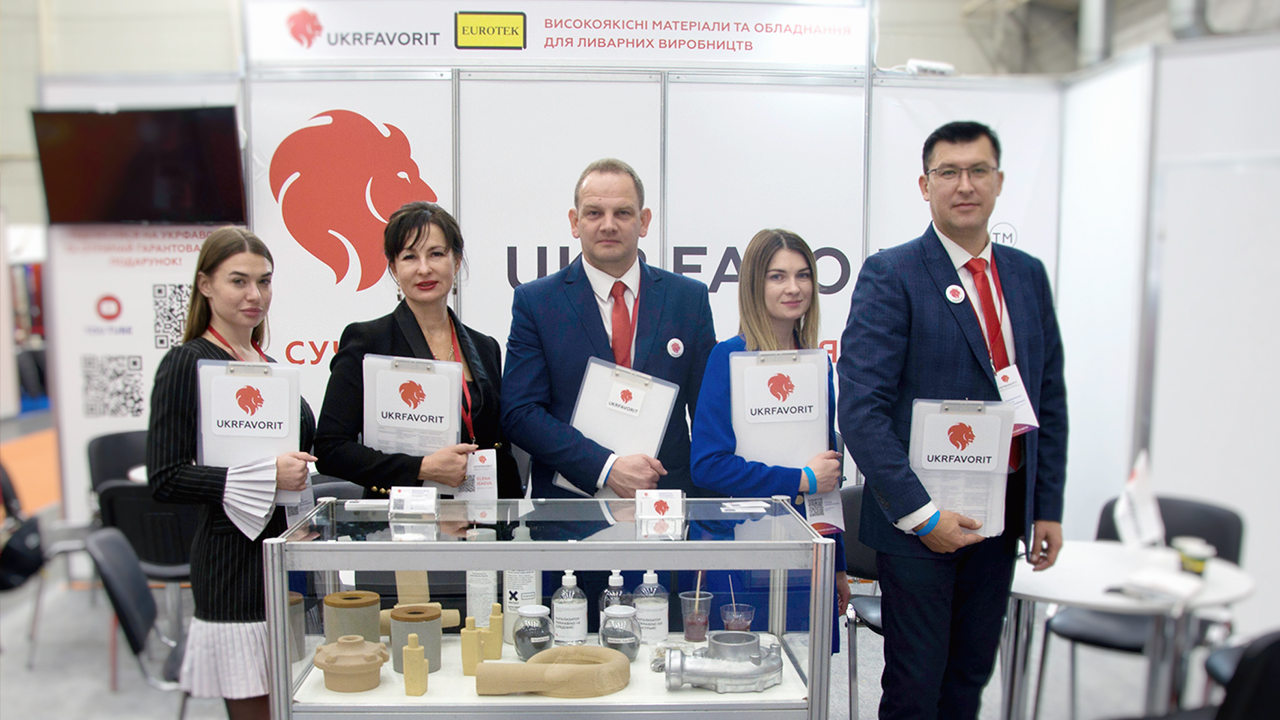
Owner of Ukrfavorit LLC Olena Isayeva at GIFA-2023, Düsseldorf
Dear colleagues, we will be glad to hear from you examples and your achievements in using modern industrial standards at your enterprises. For our part, we always popularize all useful innovations and try to implement ideas for improving the work of foundries. We attend exhibitions and events related to the latest technologies and research of Industry 5.0. After all, this is an important competitive advantage when entering European markets.
If you have any questions, please contact us.
We will be happy to cooperate!
0800339285 (toll-free)
+380504780244 – Volodymyr
E-mail: info@ukrfavorit.com.ua
Materials for the article were provided by
Head of Sales Department, Ukrfavorit LLC
Shumeiko Volodymyr