


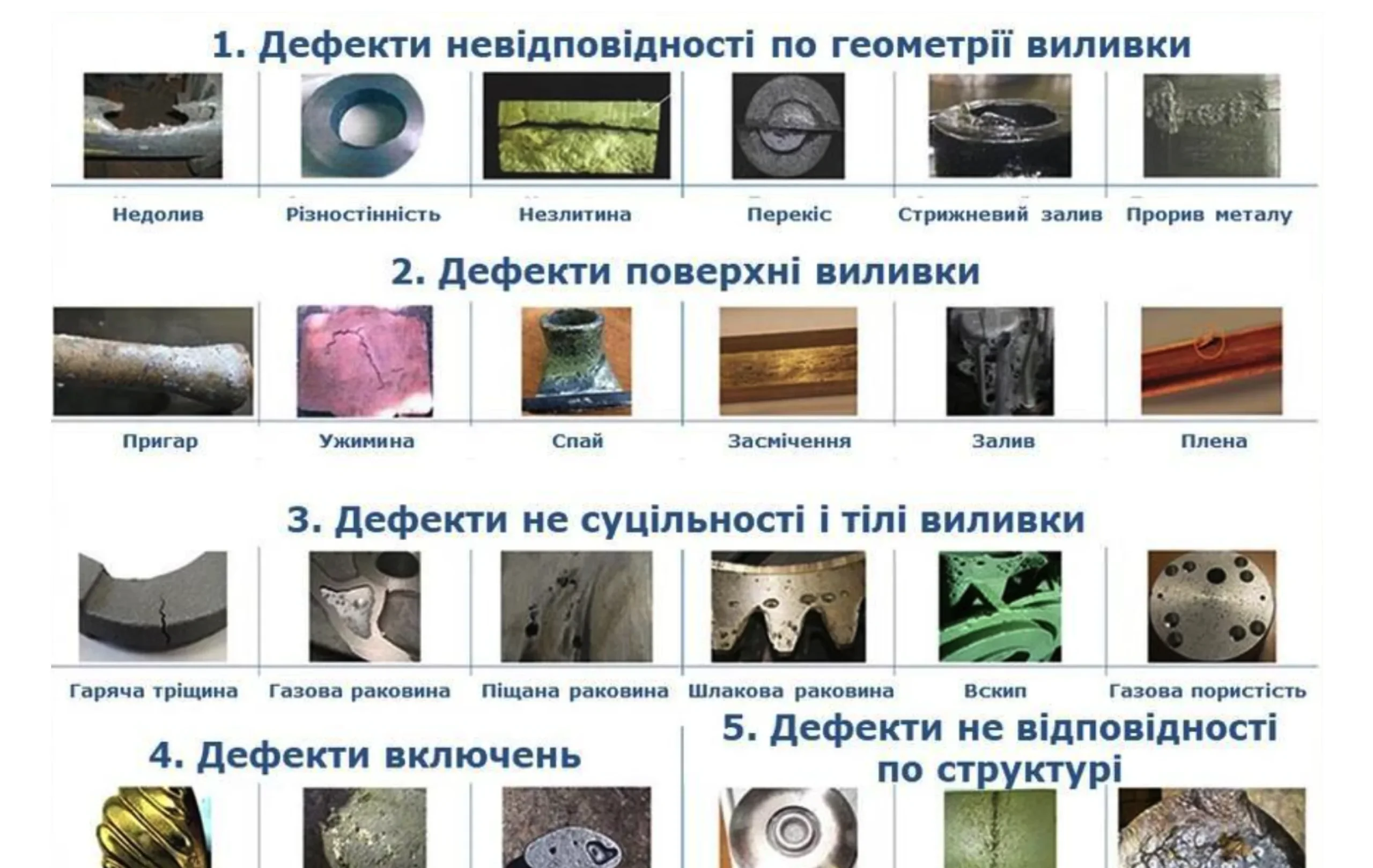

According to DEST 15467-79, a defect is a non-compliance of a workpiece or casting with the requirements imposed on them. If a product has one or more non-compliances, it is considered defective. Accordingly, a certain quality indicator by which the part was tested exceeded the current regulatory values. This does not mean that it cannot be used: the situation can probably be corrected by various methods or further processing of the product.
Let’s consider the classification of types of defects adopted in accordance with the current DEST. But first, let’s figure out which groups a product that does not meet the specified parameters can fall into:
- Suitable. This includes castings that fall under current standards and technical requirements.
- Conditionally suitable. They have minor deviations that do not affect functionality or performance.
- Correctable defect. These products may have one or more defects that can be eliminated in various ways. After that, the part can be used for its intended purpose.
- Final defect. Existing defects cannot be corrected, or it is simply not economically viable. This category usually includes workpieces that have irreparable deformations.
Both a shop worker and an employee of the technical control department can classify a casting into one category or another. Methods for eliminating defects are selected individually, taking into account the condition of the casting.
Types of defects
There are several options for classifying casting defects:
- Obvious. Defects are visible visually when inspecting the workpiece. Obvious defects also include those that are detected by instrumental means, provided that the procedure is prescribed in the regulatory documentation.
- Hidden. Such discrepancies are not visible to the naked eye and are not detected using appropriate equipment. They can be identified during further processing of the product, during operation or during flaw detection.
DEST 19200-80 states that there are five types of classification of part defects: by geometry mismatch, by surface defects, by discontinuities in the body, the presence of inclusions, and by structural mismatch. Let’s analyze them in more detail.
Geometric inconsistencies
This group includes 13 types of casting defects. These include:
- Underfill. Occurs due to a small amount of liquid metal entering the mold.
- Non-pouring. It is usually caused by damage to the sprue system or wear of the model equipment. It also occurs due to a violation of the technology of pouring molten metal.
- Non-fusion. It is a gap or through hole that forms in the walls of a part. The reason is usually that the opposing flows of melt supplied through the sprue could not merge into a single whole. It often occurs when working with metals that are characterized by a large crystallization interval, as well as when creating thin walls of the part. Non-fusion is usually detected visually. It can also appear because the mold is filled with the melt slowly or its temperature does not meet the standard.
- Crimping. It is caused by deformation during transportation, assembly, pouring, etc.
- Bloating. Occurs because the mold was not dense enough to support the weight of the metal. Often occurs in steel and cast iron.
- Classic or core misalignment. In these cases, the displacement of parts of the mold or holes occurs due to misalignment. Usually the cause is a malfunction of the tooling.
- Variability. The thickness of the walls in the workpiece is different. This is visible visually. The main reasons are poorly assembled molds, damage to the tooling.
- Core filling. The design hole or cavity is filled with metal. This occurs due to damage or collapse of the core.
- Grooves. A so-called lens is formed, which can be convex or concave. Characteristic for products with a flat, even surface. Usually occurs due to stresses acting during cooling.
- Breakage. Formed when removing the core or sprue system, as well as when improperly storing, transporting or cleaning the product.
- Notch. In this case, the contour of the part is distorted when cleaning, cutting, or removing the sprue.
- Metal exit. A void appears in the part, covered with a thin crust. The remaining metal goes into the mold or flows out of it.
- Breakthrough. The shape of the casting is distorted, it may not be completely made.
Most of these defects can be corrected, except for loss of shape.
Surface defects
They usually arise because various complex physical and chemical processes occur when the hot metal and the mold come into contact. Let’s consider them in more detail:
- Burn-in. A dense, poorly separable layer forms on the surface. It usually appears when working with refractory metals when pouring them into sand molds.
- Oxidation. A thin layer of oxidation appears on the surface due to prolonged heat treatment.
- Roughness. Usually formed due to the fact that gas bubbles are released when the metal and the mold come into contact.
- Splice. Characteristic round depressions are formed on the surface. This occurs because the portions of metal fed through the sprues to the mold are not completely joined. This can occur due to low melt temperature or due to process violations.
- Capping. A separate layer of oxides or metal forms on top of the part. This occurs because the casting was done unevenly.
- Wrinkling. Waves appear on the workpiece. This situation usually occurs in the case of thermal deformation of the surface layer or poor melt flow.
- Wrinkle. This is a small depression, the edges of which are filled with molding compound. The cause is the oxidation of the mold under the sharp impact of the melt.
- Boiling. On a certain part of the part, an accumulation of numerous growths and shells is visible. Moreover, they can be both on the surface and inside the workpiece. The reason is a high level of vapor formation when wetting parts of the mold or core.
- Clogging. There are patches of molding material remaining on the surface of the product due to poor tamping or other reasons.
- Growth. Usually occurs when the mold has been partially damaged. Most often, the growth can simply be cut off or filed off.
- Intersects. These are small strips of metal that appear when there are cracks in the mold.
These are just some of the surface defects. There are others: rough surface, bays, etc.
Presence of heterogeneity
When considering the classification of defects according to DEST, it is necessary to mention discontinuities that sometimes occur in the body of the part being manufactured. These include:
- Hot crack. It appears as a crack with a broken shape, since the defect occurs at the boundaries of crystals. In most cases, it forms in castings due to poor shrinkage during solidification of the alloy.
- Cold crack. This is a break that occurs on a hardened surface. It is usually straight in shape. It is formed due to high internal stresses.
- Shrinkage sink. It is a cavity with a rough or oxidized surface. It occurs due to a poorly designed or insufficient sprue system.
- Gas shell. Usually resembles a sphere with a smooth surface. It occurs due to the formation of gases released upon contact with the hot metal molding mixture.
- Sieve-like shell. Similar to porosity in the form of thin, long shells, which are usually located below the surface of the workpiece. The cause is hydrogen, which is present in the solidifying melt.
- Shrinkage porosity. Numerous pores form on the surface of the workpiece. They arise because the metal has shrunk or the power supply was poorly organized. If the workpiece is made of cast iron, then the so-called graphite porosity may occur.
- Weight loss. A mechanical defect that is a small depression on the surface. The cause is poor feeding of the mold.
- Presence of sand shell. Formed due to improper molding or insufficient strength of the mold. Slag shell may also occur.
This is far from a complete classification of defects in metals and castings. More detailed information can be found in the DESTs.
Presence of inclusions
The last group is inclusions, which are metallic or non-metallic particles that have entered the part. This group includes:
- Korolok. This is the name given to spherical pieces of metal that are spatters that have entered the mold during improper pouring. They do not fuse with the main plane.
- Metal inclusions. Formed due to poor mixing of the composition and low homogenization of the mixture.
- Non-metallic inclusions. Occur due to mold damage, chemical processes during melting and contact with the molding mixture.
In most cases, they arise due to violations of the technical process.
Structural inconsistencies
Usually formed due to the presence of massive parts or thin walls. These include:
- Bleaching. Occurs when working with gray cast iron due to the presence of free cementite in the structure. Most often it is visible in thin sections. It is formed in compositions of irregular configuration in terms of chemical properties.
- Liquation. A common phenomenon associated with the enrichment of a certain area of a part with impurities or melt components. Occurs during shrinkage processes due to selective crystallization.
- Flocken. The casting body breaks due to the fact that it contains a lot of hydrogen, and internal stresses also arise.
In most cases, all of the above defects occur due to non-compliance with technology, shrinkage, and errors in the creation or design of molds.
E-mail: info@ukrfavorit.com.ua
Call: 0800 33 92 85 (free of charge)
Ukrfavorit Press Service


