


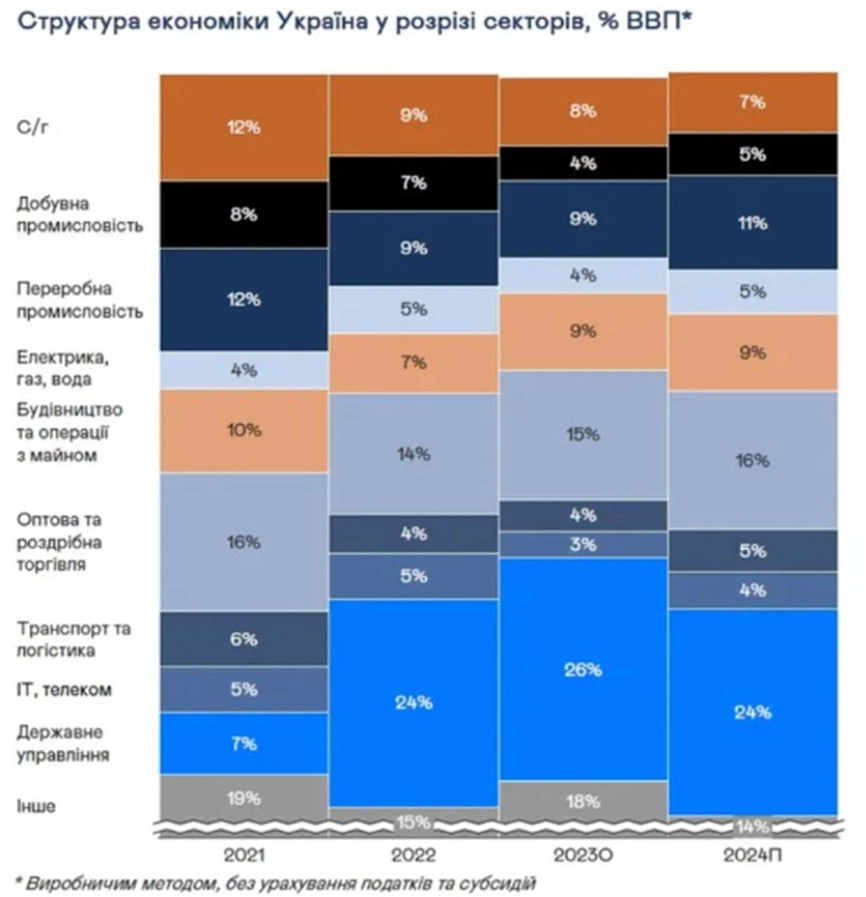
According to the results of 2022, the share of the public sector in GDP reached a record high of 24%. In 2023–2024, this share will stabilize at 24–26%. According to the decision of the National Security and Defense Council and the President of Ukraine, at least 21.6% of the total financial resources from the budget should be allocated for 2024.
The processing industry has the potential for rapid recovery due to the need to process agricultural raw materials and the “5-7-9” preferential lending program with state support.
Ukraine’s exports and imports
Looking at data on the structure of Ukraine’s gross domestic product by final use, we can see the dynamics of the ratio of Ukraine’s exports and imports in recent years.
Ukraine’s foreign trade balance from 2005 to 2025

Source: https://index.minfin.com.ua/ua/economy/gdp/eximp/
Obviously, along with the growth in the volume of export and import operations, imports to Ukraine chronically exceed exports, and the difference between them is growing.

Source: https://index.minfin.com.ua/ua/economy/gdp/eximp/
Trends of the last decade
The YouControl team researched economic trends between 2010 and 2019. For a detailed analysis of growth rates among the 42 sectors identified by analysts, the top 20 were selected, which generated 95% of the country’s total economic revenue. The conclusions are as follows.
The leading sectors of the Ukrainian economy in terms of revenue in 2019 were wholesale (30.5%) and retail (8.1%) trade. The next steps in the ranking are occupied by: electric power industry (7.8%), food industry (6.6%), transport and logistics (5.6%), agriculture (5.6%), metallurgy (4.9%). This industrial-agricultural structure of the economy indicates a low share of high-tech production and insufficient depth of product processing to maximize added value.
Levers of the economy

Share of economic sectors in the overall income structure: leaders and outsiders
The fastest growth rates were seen in sectors such as healthcare (up from 0.19% to 0.53%, i.e. 2.7 times compared to the baseline in 2010), while the shares in total revenues of agriculture (from 2.8% to 5.6%) and tobacco production (from 0.3% to 0.6%) also doubled.
Along with the strengthening of certain sectors, there were also outsiders in the economy in terms of the decline in their share of income. For example, the share of the financial sector at the beginning of 2020 was only 21% of its share in the economy in 2010. The second and third places in terms of the decline in income share were occupied by related sectors of the coke chemical industry (43%) and metallurgy (70%).
Source: https://yur-gazeta.com/golovna/amerikanski-girki-ukrayinskoyi-ekonomiki.html
Ukraine’s foreign trade balance in 2025 is characterized by a significant trade deficit. Exports of goods and services declined, imports of goods increased, and the trade balance deteriorated. At the same time, there is a positive trend in the form of an increase in grants to Ukraine and a decrease in imports of services.
Source: https://index.minfin.com.ua/ua/economy/gdp/eximp/
Nominal GDP of Ukraine from 2002 to 2024.
(GDP in dollars – according to World Bank and IMF data)

Source: http://www.worldbank.org, http://www.imf.org
Steel production in 2024 exceeded expectations
Steel production in Ukraine in 2024 turned out to be much better than expected. At the end of the year, it may reach 7.5 million tons, which is 21% higher than last year. In 2021, steel production in Ukraine amounted to 21.4 million tons.
The “maritime corridor,” launched at the end of 2023, helped relieve traffic congestion on the western borders and simplified the logistics of steel exports. In the spring of 2024, a second blast furnace was launched at AMKR, resulting in an increase in exports of semi-finished products by 650,000 tons, or 60%, in the first 11 months of 2024, and rolled products by 500,000 tons, or 40%.
The “maritime corridor” also contributed to the resumption of iron ore exports to China. In the first 11 months of 2024, 13.0 million tons of iron ore were delivered to China from Ukraine, accounting for 43% of Ukraine’s total iron ore exports.
Our forecasts for 2025 are based on increased risks and challenges for the entire mining and metallurgical complex of Ukraine. The sum of these challenges and their negative consequences will directly affect the reduction in the volume of production and export of mining and metallurgical products.

Source: https://gmk.center/ua/posts/perspektyvy-metalurhii-ukrainy-u-2025-rotsi/
Ukraine’s mining industry: results of 2024 and prospects for 2025
In January-April 2025, exports of iron ore products decreased by 20.9% in value terms (to $892.99 million) and by 10.2% in physical terms – to 11.15 million tons. This means a loss of more than $235 million in foreign exchange earnings in just four months. According to GMK Center forecasts, by the end of 2025, iron ore exports from Ukraine will decline by about 20% y-o-y, to 27 million tons from 33.6 million tons in 2024.
Production figures also show negative dynamics. In particular, Ferrexpo, one of Ukraine’s three largest iron ore companies, reduced production by 26% in the first quarter to 1.35 million tons. In May, the company announced that it had shut down two pellet production lines due to the non-refund of VAT on exported products. The total expected shortfall in production in 2025 is estimated at 4 million tons.
In 2024, the mining and metallurgical complex accounted for about 7% of GDP and provided 15% of Ukraine’s foreign exchange exports. However, in 2025, the sector is facing a number of systemic problems, some of which are administrative in nature.
The mining industry does not require direct budget financing. For stable operation, it needs a predictable regulatory environment, timely tax credit refunds, and an economically sound tariff policy. Under current conditions, every ton of iron ore production generates foreign exchange earnings, tax revenues, and jobs. Underestimating the strategic importance of the industry hinders the country’s economic recovery potential and creates long-term risks to its financial stability.

Production of steel, cast iron, and rolled products at metallurgical enterprises in Ukraine for the period 2020–2025

Data for 2025 is provided for the first four months.
**Data for 2025 is provided for the first quarter.
2020–2021: Ukraine was one of the world’s leading steel producers, with an annual production volume of over 20 million tons.
2022: Steel production fell by 70.7% to 6.3 million tons.
2023: Production remained low, with a slight decline to 6 million tons. 2024: The industry recovered, with steel production growing by 21.6% to 7.58 million tons, pig iron by 18.1% to 7.09 million tons, and rolled steel by 15.8% to 6.22 million tons.
2025: In the first four months of the year, steel production increased by 1% compared to the same period in 2024, to 2.43 million tons. However, due to the threat of closure of the only coking mine in Pokrovsk, steel production is expected to decline to 2–3 million tons by the end of the year.


Global steel production in January 2025 amounted to 151.39 million tons, which is 4.4% lower than in January 2024 (158.37 million tons).
China is also the leader here, producing 81.91 million tons, which is 5.61% lower than in January 2024 (86.78 million tons). China’s share in global steel production is 54.1%.
Ukraine (0.61 million tons, or 112.28% compared to January 2024) ranks 20th among 71 steel-producing countries.

Source: https://censor.net/n3537859


Locations of foundries in Ukraine
In Ukraine, 840 enterprises have relocated to safer regions under the relocation program, of which 667 are already operating in their new locations. This is evidenced by data from the OpenDataBot platform.

Source: https://zbruc.eu/node/116763
Structure of the public road network
Currently, there are nearly 170,000 public roads in Ukraine. Medium repairs, i.e., patching holes.

The problem of road quality in Ukraine is so acute that more than one team of developers is trying to solve it. Recently, IGate wrote about the Navizor project. Almost simultaneously, programmers from the web studio Stfalcon.com launched another service, “Roads of Ukraine”, which allows users to evaluate the quality of road surfaces, this time in automatic rather than manual mode. The “Roads of Ukraine” project invites everyone to participate in compiling a map of domestic highways.
Source: https://igate.com.ua/news/15858-startap-kotoryj-znaet-gde-na-dorogah-yamy

Source: https://api.visicom.ua/uk/posts/ukravtodorplusvisicom
Approximately 500 tons are required per 1 km of road. Lithuania has various purposes, meaning that 85,000 tons per year are required to maintain Ukrainian roads.
* According to data from the Ministry of Community, Territorial and Infrastructure Development of Ukraine
Total length of railways in operation

Source: https://vkraina.com/karta-zheleznyh-dorog-ukrainy/
The total length of railways is about 25,000 kilometers. To ensure its operation, Ukrainian Railways must use about 250,000 tons of ballast per year, which means that 10 tons of ballast are used per 1 km of railway.
Agricultural land in Ukraine
Most agricultural land is cultivated in the Odessa, Zaporizhia, and Kharkiv regions, with more than 2 200 000 hectares. The least amount of land is available to residents of the Zakarpattia and Chernivtsi regions, with less than 500 000 hectares.
It should be noted that according to the results of research conducted by scientists at the Institute of Agricultural Economics, the highest cost of renting one hectare of state-owned agricultural land was recorded in the Kirovohrad region – 8.4 thousand UAH, and the lowest – 0.9 thousand UAH – in Zakarpattia.

The annual supply of castings to the agricultural sector amounts to 500 thousand tons per year.
The specific weight of cast products in machine-building products

Key facts
- According to the study, 74% of respondents said they currently experience a shortage of personnel, 17% said they experience a partial shortage, and 7% said they do not experience a shortage of personnel.
- According to businesses, the main problems in Ukraine’s labor market today are: talent shortages, mobilization, the desire to work remotely, the outflow of skilled workers abroad, employee burnout and fatigue, and others.
The participants in the study noted that companies have planned the following changes for this year:
- increase in salary levels (72% of respondents);
- increased budgets for training and development (39%);
- increase in the number of employees (35%);
- entering other markets and searching for new partners (32% of respondents).
67% of survey participants plan to open new vacancies this year.
At the same time, 48% of respondents reported that the number of employees in their companies would remain unchanged in 2024, while 5% of respondents wrote that their companies were planning to reduce the number of employees.

The study was conducted between February and April 2024. It involved 109 HR professionals (49% were department heads, 24% were middle managers, 26% were top managers, and 3% were junior staff).
More than 60% of survey participants represent international businesses. 50% of companies are large businesses, 43% are medium-sized businesses, and 7% are small businesses.
Recently, the National Bank of Ukraine predicted a further decline in unemployment and an increase in wages, as stated in its January Inflation Report. Demand for skilled workers will increase, especially if the security situation improves next year.
The staffing situation in 2024
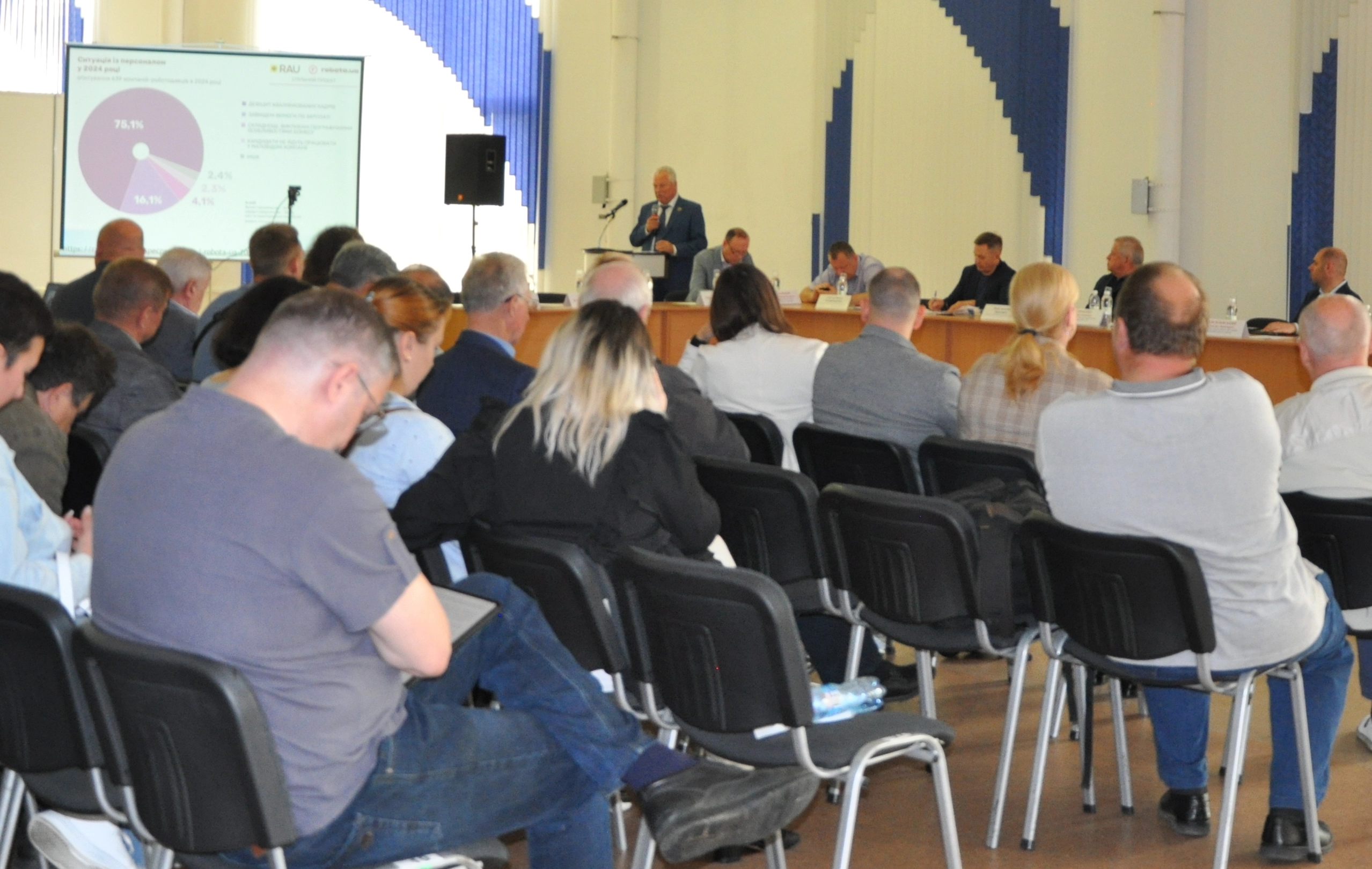
It is no secret that there is a shortage of qualified employees in virtually all sectors of the Ukrainian economy. This was confirmed once again by a business survey, which found that 75.1% of companies are unable to find experienced staff. Only 16% of people are lacking due to their inflated salary expectations. Similarly, geographical characteristics of the business prevent hiring in only 4% of cases.

Source: https://rau.ua/novyni/specproekt–rau–i–robota–ua-2024-2/
Director of the State Department of Foundry Production, Ph.D. in Engineering
Klymenko Stepan Ivanovich
Sirenko Kateryna
Kyiv
May 28, 2025
How to contact us?
Write to us: info@ukrfavorit.com.ua
Call: 0800 33 92 85 (free).
Scan the QR code and join our social networks!

Together we move the industry forward!
E-mail: info@ukrfavorit.com.ua
Phone:
+38 (067) 333-92-85
+38 (066) 333-92-85
+38 (044) 333-92-85
0800 339 285 (free)
Press service of “Ukrfavorit”


