


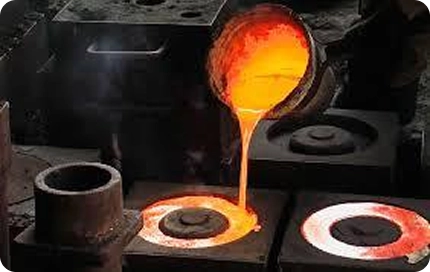
Among the various types of production used to produce blanks (parts), the most important place belongs to foundry production. Approximately 70% (by weight) of blanks (parts) are produced by casting methods, and in some branches of mechanical engineering, for example, in machine tool construction, 90-95%.
This is explained by the fact that casting methods allow the production of blanks weighing from several grams to hundreds of tons with a wall thickness of 0.5…500 mm and more, with dimensions from several millimeters to tens of meters of the most complex shape, which cannot be produced by other technologies from plastic or brittle alloys. Casting methods also allow the production of a cast blank (cast part, casting), as close as possible to the shape of the finished product, which significantly reduces metal consumption and the volume of machining. In addition, the production of cast blanks (cast parts, castings) is much cheaper than blanks manufactured by other methods, for example, by pressure treatment (forging), welding, etc.
The production of a cast workpiece (cast part, casting) occurs by filling the mold cavity with liquid metal (material), which has the configuration of the desired finished product (Fig. 1). After crystallization and cooling of the metal (material) in the mold, the resulting cast workpiece (cast part, casting) is removed or knocked out of the mold and subjected to further processing.

Figure 1 – The essence of the casting process
When developing a casting technology, it is very important to make a well-founded choice of the most rational methods that provide the necessary operational properties of cast parts, as well as high technical and economic indicators of production: obtaining high-quality cast blanks (cast parts, castings) at their minimum cost; high productivity; saving metal due to reduced allowances for machining; saving fuel, electricity and auxiliary materials; maximum use of available equipment and facilities.
Before proceeding with the design of the technology for manufacturing a cast workpiece (cast part, casting), it is necessary to assess the possibilities and feasibility of fulfilling the order at a given enterprise, guided by the technical capabilities of various casting methods, general principles of classifying castings according to their characteristic features, information on the capacity of lifting and transport vehicles, the availability of the necessary technological equipment, molds, as well as other equipment and tools (adaptations).
The drawing details indicate technical requirements with references to standards or special conditions that are stipulated by special technical instructions (instructions).
When analyzing an order, the purpose of the cast workpiece (cast part, casting), size, production series, and complexity group are taken into account in accordance with economic indicators.
Designing the technological process for manufacturing a cast workpiece (cast part, casting) includes developing the necessary technological documentation: drawings, calculations, process maps, etc.
The volume of technological documentation depends on the type of production (single, small-scale, serial, mass). In the case of single production, all technological instructions are applied directly to the drawing of the part. In serial and mass production, based on the analysis of the technical conditions for the part and its design, calculations, as well as reference data, separate drawings of the cast blank (cast part, casting), drawings of models, core boxes, model plates are developed. The rules for drawing the elements of the casting mold and the cast blank (cast part, casting) are established by the relevant regulatory documents of the enterprise, as well as standards.
The technology of production of cast blanks (cast parts, castings) begins with the manufacture of their models, models of elements of the sprue system, design of core boxes, selection of molds, model plates, templates for checking the dimensions of the mold and cores. All this is called a model kit and is manufactured either in the model section of the foundry or directly in a separate model shop of the plant.
The next stage of the casting technology is the preparation of molding materials. In the appropriate department of the workshop, these materials are dried, sieved and sent to the department for the preparation of molding and core mixtures.
After this, the molds and cores are made in the forming and core departments of the shop. The molds are also assembled there before being poured with liquid metal. This entire process is called forming.
An important link in the technological process is the preparation of liquid metal – melting, which begins with the preparation of charge materials at the appropriate charge composition of these materials. Here they are sorted and, after checking the chemical composition, are fed to the melting department of the shop.
After melting and bringing to the appropriate composition and temperature, the molten metal from the melting units (furnaces) is poured into pouring ladles, which are preheated to a given temperature depending on the type of alloy and fed for pouring into assembled casting molds. After pouring and crystallization of the metal, the cooled cast blanks (cast parts, castings) are removed (knocked out) from the mold and sent to the department for cleaning from scorching and cutting off the remains of the gating system. After cleaning, the cast blanks (cast parts, castings) are sent to the technical control department. Suitable cast blanks (cast parts, castings) are subjected to heat treatment to remove internal stresses, if necessary: annealing, normalizing, artificial aging. Then (if necessary) they are again subjected to a control operation, after which the cast products are transferred to mechanical processing.
The spent molding mixture after knocking out the molds and cores is cooled and undergoes a regeneration process (cleaning from metal residues, dust, dirt). Subsequently, the regenerated mixture is reused in the preparation of molding mixtures for the manufacture of casting molds.
If you want to learn more about the features of casting methods and techniques, processes, and stages of designing cast blanks (cast parts, castings), we recommend contacting Ukrfavorit LLC. Here you can receive detailed advice on the necessary equipment and materials for the production of high-quality cast blanks (cast parts, castings). The company employs professional engineers who will answer your questions and help you modernize existing foundry equipment, implement new processes, and increase the profitability of your company’s production.
How to contact us?
Write to us: info@ukrfavorit.com.ua
Call: 0800 33 92 85 (free).
Scan the QR code and join our social networks!

Together we move the industry forward!
Press service of “Ukrfavorit”


